


Elosuchus: The Ancient Crocodile Relative
Imagine a world where enormous predatory dinosaurs roamed the land, giant pterosaurs flew overhead and crocodile relatives hunted in the rivers below. Around 95 million years ago, this was the reality in what is now Morocco.
Elosuchus fossils comes from the famous Kem Kem Beds, a fossil-rich region of North Africa known for its incredible collection of prehistoric animals. Dating to the Late Cretaceous, their fossils offer a fascinating connection to an ecosystem filled with some of the most impressive predators ever to have lived.

What was Elosuchus?
Elosuchus was an extinct genus of crocodyliform, a member of the wider group of reptiles that includes modern crocodiles and their extinct relatives. Although it was not a dinosaur, it lived during the same period and shared its environment with several famous dinosaur species.
Unlike modern crocodiles, which often have broader snouts, Elosuchus had an elongated, narrow snout and slender jaws lined with numerous teeth. These features are associated with catching fish and other prey, making it well suited to hunting in aquatic environments.
Some estimates suggest that Elosuchus could grow to around five metres long. This would have made it a substantial predator, capable of taking advantage of the abundant fish and other animals living in the waterways of prehistoric Morocco.
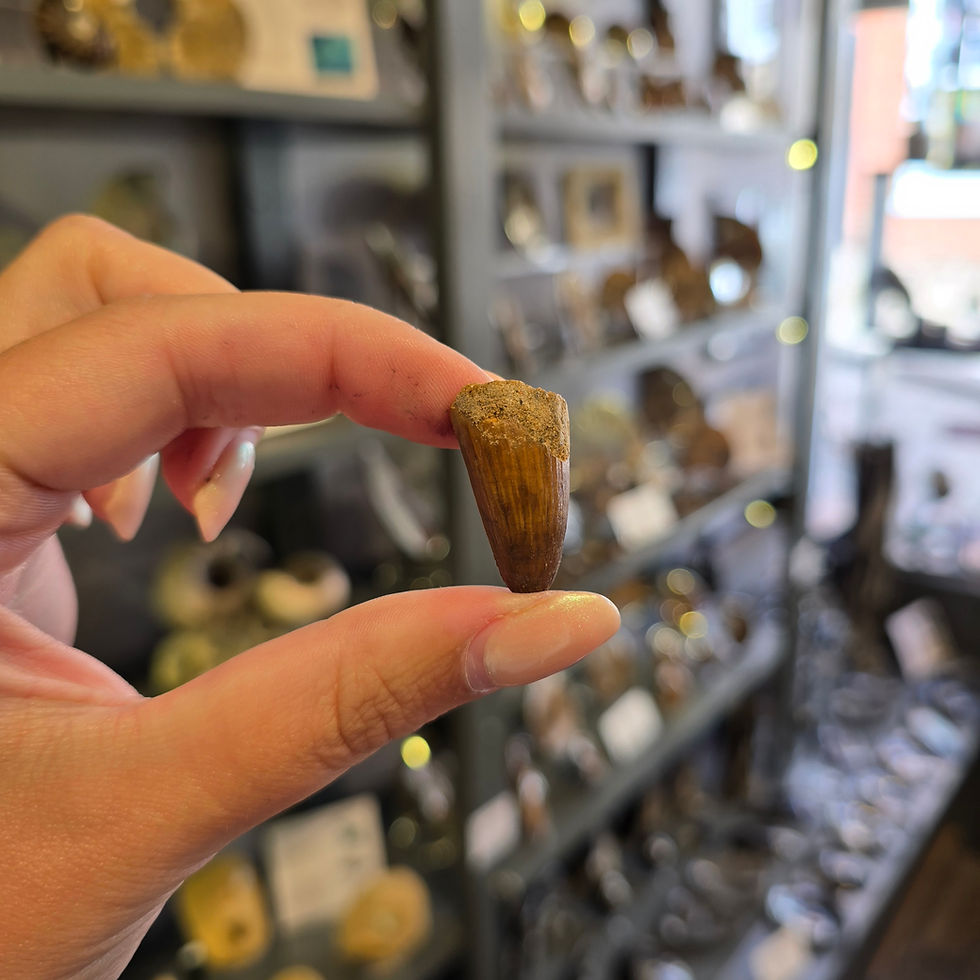
What can a fossil tooth tell us?
Teeth are among the most useful fossils for understanding prehistoric animals. Unlike bones, which can be fragile and easily damaged, teeth are made from extremely hard tissues that can survive the fossilisation process particularly well.
The shape of a tooth can offer clues about an animal's diet and lifestyle. Sharp, pointed teeth are useful for gripping prey, while the arrangement and shape of teeth across the jaws can help palaeontologists identify different groups of animals.
Where was Elosuchus found?
This fossil originates from the Kem Kem Beds of Morocco, an internationally famous fossil deposit in southeastern Morocco, near the edge of the Sahara Desert.
Today, the region is dry and desert-like, but around 95 million years ago it looked very different. During the Cretaceous Period, the area contained river systems and swamp like environments, where water carried sediment and deposited it across the landscape. These ancient waterways supported a diverse range of animals, from fish and turtles to crocodile relatives, pterosaurs and dinosaurs.
The Kem Kem Beds are particularly well known for producing fossils of large carnivores. Their discoveries include Spinosaurus, Carcharodontosaurus and Deltadromeus, alongside a variety of other prehistoric reptiles.
The fossil record from this region is unusual because it contains a remarkable number of large predators. It provides an important window into the ecosystems of North Africa during the Cretaceous, although the types of fossils preserved and discovered do not necessarily represent every animal that lived there.


Comments