


From Sea Floor to Marble: Is a Goniatite an Ammonite?!
- lapidartlincoln
- Oct 15, 2025
- 2 min read

Goniatite fossils are among the most fascinating remnants of ancient marine life. These coiled, chambered shells belonged to an extinct group of ammonoids that thrived during the Palaeozoic Era, roughly between 400 and 250 million years ago. They were especially abundant in the Devonian and Carboniferous seas, long before the rise of the dinosaurs. The intricate patterns on their shells, known as suture lines, are simpler than those of the later ammonites, giving goniatites a distinct, almost primitive beauty that sets them apart from their Mesozoic relatives.
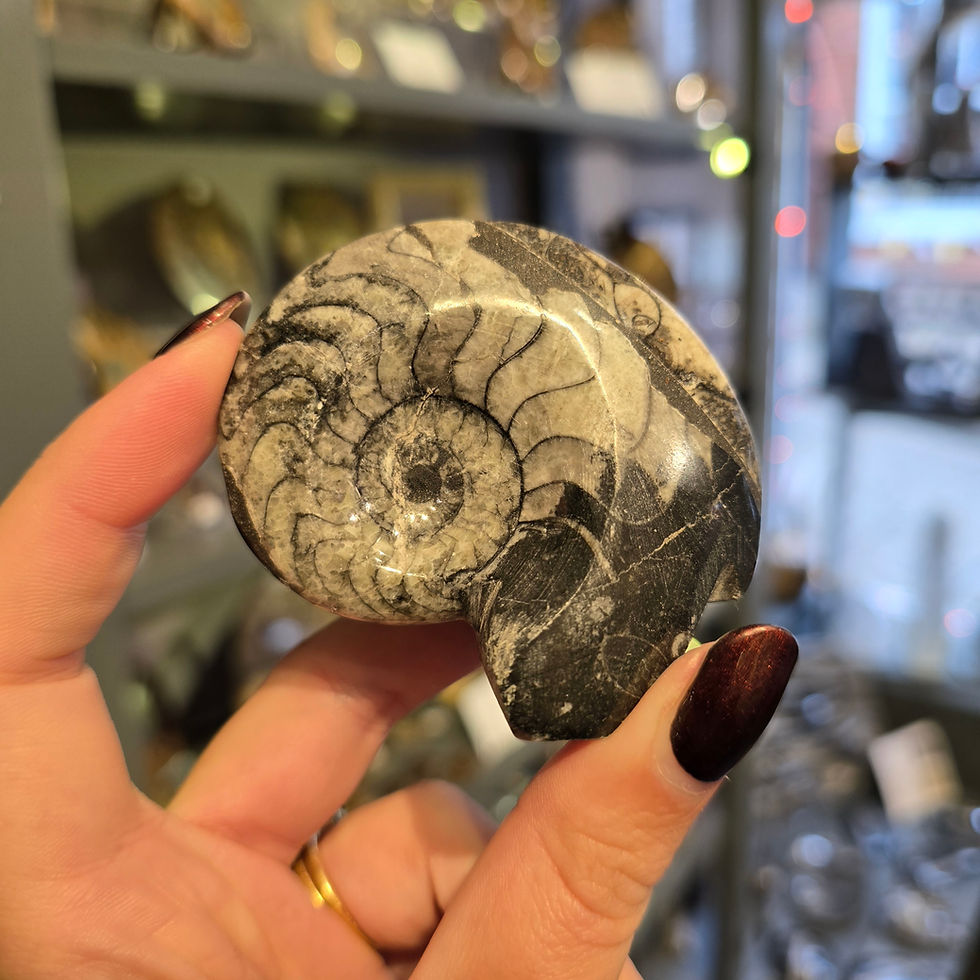
The world goniatites inhabited was very different from ours. Much of the Earth’s surface was covered by warm, shallow seas teeming with coral reefs, crinoids and trilobites. Goniatites were free-swimming predators, likely feeding on small crustaceans and plankton. Their shells helped them regulate buoyancy much like modern squids or nautiluses do today. Despite surviving several extinction events, goniatites eventually disappeared at the end of the Permian Period, the largest mass extinction in Earth’s, which wiped out around 90% of marine species.
Is a Goniatite the same as an Ammonite?

This is a very common question, the answer is both yes and no depending on how precisely you use the term ammonite. Goniatites and Ammonites are closely related, but they’re not the same thing. Both belong to a larger group of extinct marine molluscs called Ammonoidea, which were shelled relatives of modern squids and nautiluses. Within that group, goniatites represent an older, more primitive branch that lived during the Palaeozoic Era (about 400–250 million years ago). Ammonites on the other hand, evolved later in the Mesozoic Era during the age of the dinosaurs.
In everyday conversation, people often call all of them ammonites, but scientifically, goniatites are a distinct and older group within that lineage.
Why are Goniatites found in marble and not rock?
Goniatites are mainly found in marble (more accurately, marble-like limestone) because of the geological processes that affected the rocks where they were originally buried.

When goniatites died hundreds of millions of years ago, their shells settled on the sea floor and were buried in mostly limestone or mudstone. Over immense spans of time, these sediments were compressed and hardened into solid limestone. Later, in regions where tectonic activity occurred, those limestone layers were exposed to heat and pressure (metamorphism). This process transformed the limestone into marble, but often preserved the fossil shapes of the goniatites within it.
Essentially, goniatites are found in marble because they originally lived in lime-rich seas, and those lime sediments later underwent metamorphism, turning into the rock we now call marble.


Comments